(Article from UNGC)
Gender Equality in the Workplace: Where Does Malaysia Place, How and Why Do We Need to Do Better
“… In November and December, I was really, really proud to see Malaysia has more than 30% chairmanship in the GLC, Government Linked Companies and Government-Linked Investment Companies,” Datuk Noripah Kamso, former chairman of Bank Rakyat, said in a memorable webinar co-hosted by GCMY and Tulips Movement Malaysia, on the matter of the realization of the 30% women representation on public-listed corporate boards movement started by the 30% Club.
Gender equality, in its many facets and nuances, face an uphill battle in the corporate space. In a McKinsey Global Institute (MGI) report, there is a 50% drop-off of women representation in the career progression pipeline from entry-level jobs to senior management roles. This is a lost opportunity, as the same report indicates that Malaysia stands at USD$50 billion a year increase to its GDP by 2025 (An 8% increase from ceteris paribus business projection) should the corporate space advance gender equality as part of its sustainability agenda.
This by no means is meant to discredit the words of the wise former chairman. This is a call that by doing better in advocating and pursuing gender equality in business, we will get to see increased returns. To close the 76% gender pay gap (Department of Statistics Malaysia, 2017), to reduce, and ultimately rid off, gender bias in the workplace, to increase gender diversity in the workforce – all these steps are necessary in order for the Malaysian corporate space to flourish, especially in the trying times of post-COVID 19 recovery.
GCMY understands, however, that advancing the agenda of gender equality remains a puzzle, particularly for business leaders in the Small to Medium Enterprise (SME) category. With that in mind, GCMY refers to the United Nations Global Compact’s Framework for Corporate Action on Workplace Women’s Health and Empowerment (WWHE):
1. Understand Worker Needs & Operational Gaps
In a retrospective approach in identifying key issues with gender equality in a firm, it is recommended that the firm identify adequate tools, resources and local partners for needs assessment, which is then piloted and undertaken. A gap analysis of internal codes, policies and practices has to be conducted, with buy-in from those in management roles.
2. Set Priorities & Targets
From the assessment results, a plan with clear priorities and target is created to meet WWHE goals, while meeting operational needs and policies. Key in this step is to secure senior leadership endorsement with the transparent goals and effective intervention mechanisms.
3. Take Action on Women’s Health & Empowerment
The third step involves the establishing of gender-responsive policies and practices in the workplace, as well as addressing structural barriers to WWHE. WWHE goals should be factored into business risk assessments and due diligence for human rights and ESG, with business benefits linked to WWHE performance supported by business case data for the final step of the framework.
4. Measure, Improve & Communicate
Assurance of WWHE performance and its return to business has to be communicated well, via the establishment of a suitable communications program. It is also recommended that health and empowerment initiatives and data are integrated into ESG reporting and compliance monitoring. On a shareholder-level, WWHE commitments and performance benchmark should be integrated into the agenda of board meetings.
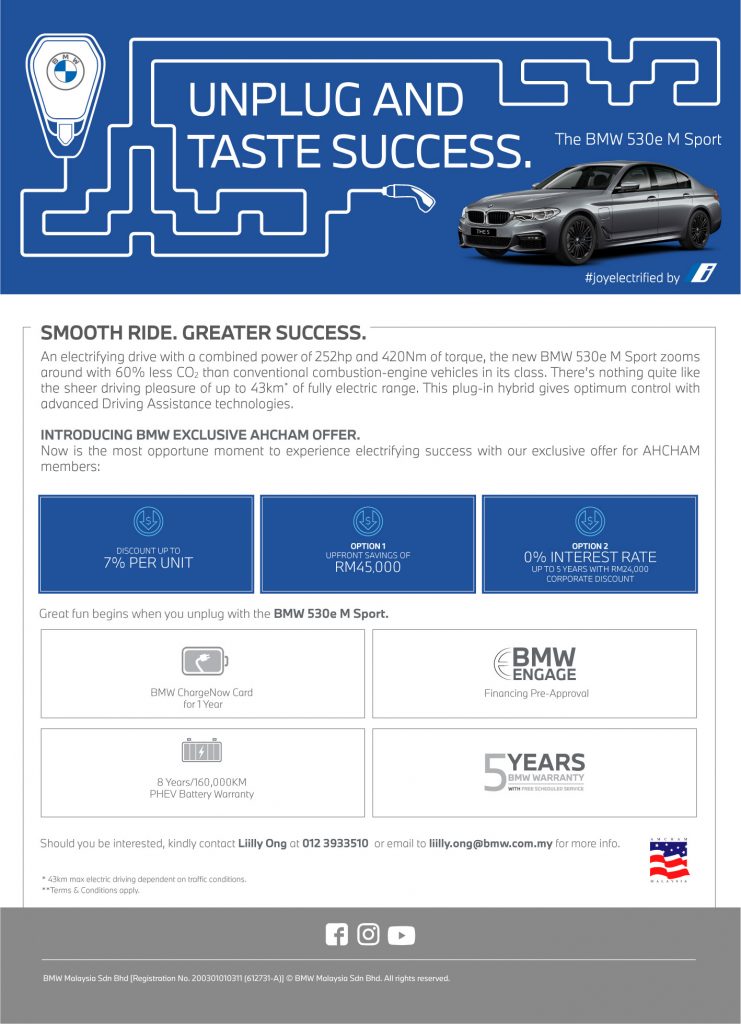
An electrifying drive with a combined power of 252hp and 420Nm of torque, the new BMW 530e M Sport zooms around with 60% less CO2 than conventional combustion-engine vehicles in its class. There’s nothing quite like the sheer driving pleasure of up to 43km* of fully electric range. This plug-in hybrid gives optimum control with advanced Driving Assistance technologies.
Contact Liilly Ong at 012 3933510 or email at [email protected]
Global value chains are being disrupted due to the COVID-19 pandemic. Adding to that were the lockdowns and the closing down of economic activity across the regions, that have decreased global trade and national GDPs. On 28 July 2020, AMCHAM held a webinar on ‘Navigating Supply Chain Disruptions’, the second webinar in the Tomorrow Series. This session looked into these disruptions, both locally and regionally, and what mitigating steps need to take place to navigate through it all successfully.
Mr. T.H. Lim, Managing Director UPS Malaysia and Singapore provided the overview on the global supply chains as well as Malaysia’s part in it, what businesses face today, the new shifts in business functions, along with changes in the business model to optimize the supply chain
Dr. Shardul Phadnis, Associate Professor and Director of Research at Malaysia Institute for Supply Chain Innovation (MISI) shared the latest findings from the two MISI studies that were conducted from April to June, both of which analyses the impact and response to the pandemic by various companies.
Both presenters also provided their view on the potential future, touching on how companies that adapted well were able to ride the storm that is the pandemic and was able to continue business operations.
The Ministry of International Trade and Industry (MITI) and Malaysia External Trade Development Corporation (MATRADE) are currently developing the National Trade Blueprint (2021-2025), which aims to enhance the country’s trade competitiveness globally. Key findings from this study will assist in developing policies and programmes to effectively address the issues and challenges faced by various stakeholders in ensuring a sustainable export growth.
We would like to invite you to participate in this survey and click here to start the survey.
http://surveys.
Please be assured that all responses shared will be treated as CONFIDENTIAL and the information will only be published in an aggregated manner.
Should you need further clarification, please do not hesitate to contact Ms. Norhaizan Abdul Ghapar (MATRADE) at +603- 6207 7428/ [email protected]. On any technical issues with the survey, please contact Ms. Kavitha Devi (IPSOS) at +603 2289 3000 ext 222/ [email protected]
Did you panic when you were unable to access payroll / financial data records from home during the Movement Control Order (MCO) because cloud computing has yet to be implemented? For some businesses, the recent MCO provided the wake-up call to drive automation and digitalisation at a faster pace.
Already on cloud computing? Do you as a HR and finance professional “know all that is to know” about cloud computing? Are you fully maximising its capabilities? Join the conversation as our experts share insights into the “know how” and “what else” for HR and finance professionals on cloud computing.
In this webinar, we will discuss:
- Is cloud computing the way forward?
- What else should we know besides cloud computing in a work from home (WFH) arrangement?
- What are the options beyond cloud computing?
Webinar details
| Thursday, 30 July 2020 | 10.00 a.m. – 11.00 a.m.
|
Join the conversation and register here!
Deloitte has taken extra measures to ensure additional security controls on the use of Zoom. We respect each organisation’s IT security policy which may restrict your participation.
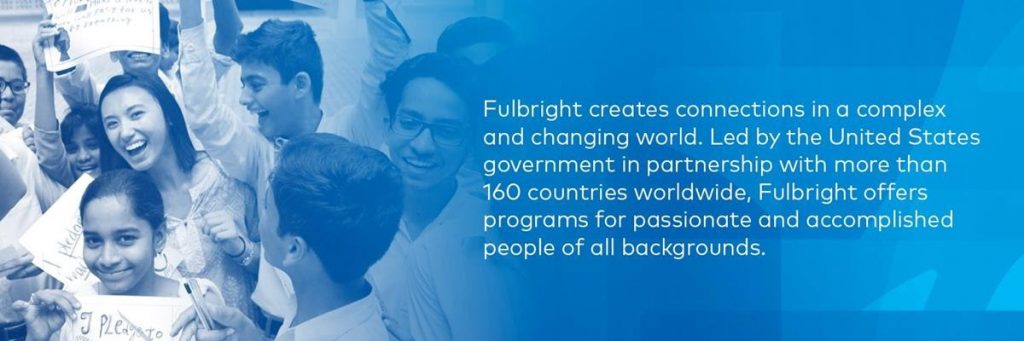
The U.S. Embassy Kuala Lumpur is pleased to share the following Fulbright Exchange Grant opportunities for educators and mid-career professionals in 2021-2022. Fulbright programs are funded by the U.S. Department of State and administered by the Malaysian-American Commission on Educational Exchange (MACEE) in partnership with the U.S. Embassy.
1. The Hubert H. Humphrey Fellowship Program provides accomplished young and mid-career professionals, a year of non-degree graduate level study, leadership development and substantive professional collaboration with U.S. counterparts. The fellowship includes professional enrichment activities such as professional visits, conferences, training programs and a professional affiliation.
For eligibility criteria and application, visit the 2021 Fulbright Humphrey program page. Application deadline: August 17, 2020.
2. The Fulbright Foreign Language Teaching Assistant Program (FLTA) provides opportunities for international educators to travel to the U.S. beginning summer 2021 to assist in the teaching of foreign languages and cultures to American students for up to 20 hours per week, while developing their professional skills and gaining first-hand knowledge of U.S. culture and society. The program includes the opportunity to take up to two university-level courses and attend a mid-year enrichment conference in December.
For eligibility criteria and application, visit the 2021 FLTA program page. Application deadline: September 4, 2020.