On 12 October, under the MY AMCHAM CARES program, AMCHAM hosted a briefing by Paul Fong, Country Director for Singapore & Malaysia of Dow Chemical on the Shoe Recycling Project in Malaysia by Dow Chemical in partnership with EcoKnights and Life Line Clothing (LLC) Malaysia. This project aims to bring together a combination of recycling and sustainability models made accessible to everyone.
Paul presented on the life-cycle of shoes and its impact on the environment if they go to incineration and landfill, and how the Shoe Recycling Project aims to put old shoes to good use via the “Reduce, Reuse and Recycle” concept. Attendees got to learn more about the project and how they can help to support the expansion of this project in Malaysia.
Attendees were active in raising questions on where the project is going and how they can contribute. Thank you to Paul Fong for conducting the very educational session.
On 11 October, AMCHAM held a Spotlight session on Smart Manufacturing by Haskell. With the growth of Industry Revolution 4.0 (IR4.0), many organizations are looking into how they can adopt IR4.0 into their manufacturing process.
Our guest speakers Jonathan Toke, Vice President of APAC of Haskell Malaysia Services and Bill Hurder, Managing Director – Asia Pacific of RoviSys went into detail on what is the challenges in a post-pandemic world and how automation can address many gaps had surfaced revealed during the pandemic.
Below are the highlights of the Malaysia Budget 2023, tabled today (7 October 2022)
- A total 450,000 households will receive monthly aid from the Social Welfare Department, totalling RM2.5billion.
- RM10 billion is allocated for cash aids under the Welfare Department and Bantuan Keluarga Malaysia. The cash aids from Bantuan Keluarga Malaysia will be expanded, with households of less RM2,500 income with five children or more will receive RM2,500 each.
- Households with income of RM1,169 will be able to enjoy electric bill subsidy up to RM40.
- Tax relief of childcare fees valued at RM3,000 will be extended until assessment year 2024.
- Income tax rates will be reduced by 2 percentage points next year. Taxable income range RM50,001 to RM70,000, the rate will be reduced from 13% to 11%. For the RM70,001 to RM100,000 range, it will go down from 21% to 19%.
- Those in the taxable income range of RM250,000-RM400,000 and in the RM400,000-RM600,000 range will be subject to a rate of 25%.
- EPF voluntary contribution limit will be increased to RM100,000 per year annually.
- Women who return to the workforce after a “career break” will be entitled to income tax exemptions for five years from 2023 to 2028.
- RM235 million will be set aside to help women build, upgrade and market their businesses, while the Securities Commission will offer training programmes to increase the number of women in leadership roles in industry.
- RM11 million allocated for mammogram and cervix cancer screening. RM8 million has been allocated for the Social Support Centre to provide advocacy and counseling sessions.
- RM305 million allocated for youths to apply loans under BSN and Majlis Amanah Rakyat (Mara) to start businesses. One can apply up to RM50,000 and it will benefit more than 10,000 youths.
- The government will bear cost for B40 youths to obtain taxi, bus, e-hailing licences under the MyPSV programme.
- National Higher Education Fund Corporation (PTPTN) borrowers who settle their loans will get discounts of up to 20 per cent. Borrowers who pay at least 50 per cent of their loan or make scheduled direct debit payments would receive a 15 per cent discount. The discount for repayments will begin from Nov 1 until April 30 next year.
- RM100 in e-wallet credit will be allocated for M40 Malaysians.
- RM800 million has been allocated for the e-wallet credit that is expected to benefit eight million people.
- Youths aged between 18 and 20 years old, and full-time students above 21 years old, would receive RM200 in e-wallet credit under the ePemula initiative.
- A total of RM332 million has been allocated for sports and to promote active lifestyles. RM145 million allocated for training programs and enhancement of sports facilities nationwide.
- RM154 million will be given to build a holistic sports ecosystem for athletes and the public.
- RM20 million will be allocated for motorsports tracks, with emphasis on promoting drag racing while RM13 million will be given for eSports development.
- Those contributing to non-government organizations (NGO) involved in sports grassroots development will be entitled to a tax exemption.
- RM12million will be allocated for para athletes.
KUALA LUMPUR, 6 October 2022 – Partnerships between landlords and occupiers are crucial in the race to decarbonise commercial real estate, and eight in 10 sustainability professionals in Asia Pacific say green leases are essential to getting both parties to cooperate on sustainability initiatives, according to a new JLL survey of 340 corporate sustainability professionals in the region.
The report – titled “Green leases: Setting the tone for responsible leases” – found that strong optimism exists among sustainability professionals, with 65% of those surveyed saying that green leases – which set shared objectives on how a building is to be improved, managed or occupied in a sustainable manner – will become universally accepted and incorporated as the new industry standard over the next three years. This optimism relies in part on green certifications and green buildings becoming a market standard in the race to net zero.
“One of the biggest value drivers for the adoption and execution of green leases is reducing building energy. Since a green lease creates mutual value between owners and tenants by reducing overall energy consumption, which translates to overall costs savings, we are working with many clients to agree on building performance standards to achieve greater energy efficiency and reduce overall energy consumption,” said Jeremy Sheldon, Head of Leasing, Asia Pacific, JLL. “On top of the accelerating net zero carbon ambitions of the various stakeholders, green leases are relevant to building owners and investors who are interested in attracting higher rentals and valuations now and into the future.”
Barriers to green lease adoption Despite the optimistic forecast of green lease adoption levels in the next three years, year-on-year growth in Asia Pacific has been slow. Currently, 42% of occupiers and large developers say they have already signed a lease incorporating green clauses – a mere 2% increase from the year before. Typically, commercial leases have imposed barriers through strict obligations, inflexibility, and fostering a short-term rather than long-term view of the value that can be achieved through real estate.
According to JLL, two of the top reasons preventing greater adoption of green leases are increased costs and the limited availability of qualified properties. Cost barriers often lead to discussions on split incentives, where landlords can be unwilling to cover upfront costs if the tenants alone benefit from the improvements, or if tenants are not able to make modifications to the space due to the constraints of the lease.
As a result, demand for assets that meet sustainability criteria is likely to outpace supply, as 43% of respondents mentioned that their organisations intend to sign a green lease by 2025 either as part of the renewal process or as a new lease. Buildings that wish to avoid incurring a “brown discount” – meaning a lower price for a less sustainable property – in the future may need to turn to other means of decarbonisation, such as undertaking deep building retrofits, to significantly reduce energy needs.

“A recent survey by the UN Global Compact Network Malaysia & Brunei (UNGCMYB) shows that about 45% of Malaysian companies have still not allocated a budget for sustainability initiatives, despite the growing trend of sustainability demands,” said YY Lau, Country Head of JLL Property Services (M) Sdn Bhd.
“This is an opportunity for us to come in and share on the need for a holistic sustainability strategy and action plan that will cost them even more in the future,” added Lau.
Moving forward with Responsible Leases JLL’s research found that data sharing, transparency, energy efficiency and waste management are the most adopted themes for green leases, which are more in line with the “E” of environment, social & governance (ESG). However, organisations need to look beyond environmental factors when considering their ESG goals in the built environment. “A green lease that incorporates social impact actions and good governance practices is a responsible lease that fully reflects wider ESG objectives. This is important as the world emerges from the pandemic and competition for talent, coupled with changes in how and where we want to live and work, have increased the importance of creating healthy spaces for inhabitants and inclusive places for thriving communities,” said Kamya Miglani, Head of ESG Research, Asia Pacific, JLL.
“Responsible leasing can unlock both short and long-term benefits for occupiers and owners, creating a framework for collaboration to drive sustainable value creation and help both sides achieve mutual goals. Moving forward, we foresee more corporates asking for social and governance clauses to be made part of commercial leasing agreements, thus broadening the scope of green leases to responsible leases.”
Download the report here
On 6 October, AMCHAM held a Members’ Briefing, virtually this time. AMCHAM’s CEO Siobhan Das updated members on the recent initiatives from the Chamber, upcoming events, government engagements and her recent participation at the World Trade Organization (WTO) program in Geneva.
Francis “Chip” Peters, Senior Commercial Officer, U.S. Embassy in Kuala Lumpur updated on the recent developments from the U.S. side, the recently announced SelectUSA Investment Summit in 2023, and the Indo-Pacific Economic Framework (IPEF). Members also got to virtually meet Dave Williams, Economic Counsellor, U.S. Embassy in Kuala Lumpur. Dave updated on civil aviation in Malaysia, the new routes opened up, and other upcoming initiatives.
Thank you to our guest speakers from the U.S. Embassy for the updates. Be on the lookout for the next Members’ Briefing which will be announced soon.
Effective 03 October 2022 (Monday), the Immigration Department of Malaysia (JIM) will implement a new facility for foreign professionals to apply Permission to Work with maximum of (30) days Social Visit Pass (PLS@XPATS) from the date of arrival to Malaysia.
The conditions of this facility are applicable for critical works in selected sectors as follows:
Permitted Sectors:
Government Sector
Government Link Company (GLC); and
Private Sector
Permitted Sectors Category:
Security & Defense
Manufacturing
Construction
Health & Medical
Oil, Gas & Energy
Finance & Banking
Electrical & Electronics
Wholesale & Retail
Tourism
Business Services
Commodity
Education
Agriculture
Aviation
Information, Technology & Infrastructure
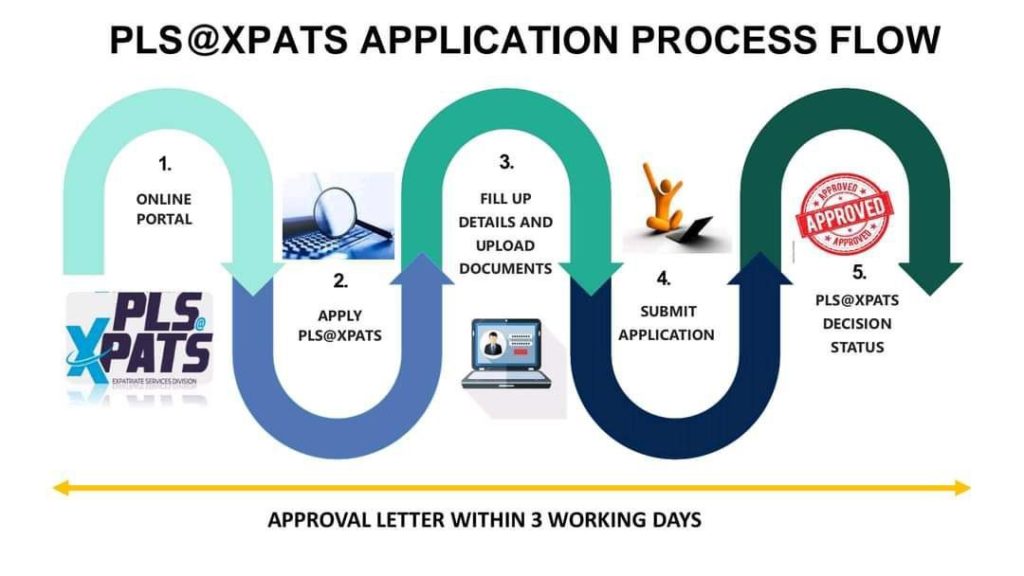
The hiring company may submit the application through Immigration online system via https://mtp.imi.gov.my/plsXpats. The processing charter is Three (3) Working Days upon complete documents submission.
The Permission to Work with a maximum of (30) days Social Visit Pass (PLS@XPATS) will be endorsed at the Immigration Entry Point, subject to the Approval Letter.
For citizens of a country who require to apply visa prior entry to Malaysia, they are required to obtain Visa Without Reference (VTR) at the Embassy / High Commission/ Consulate General of Malaysia; OR
Visa application can be made online via https://malaysiavisa.imi.gov.my for electronic visa ( eVisa).
For more information, please refer to the infographic and e-mail to [email protected] for any inquiries related to this new facility.
- Infographic on Application Process
- Below is the Application Process Flow