Prime Minister Tan Sri Muhyiddin Yassin has unveiled a host of measures in the government’s Short-Term Economic Recovery Plan aimed at alleviating the worst effects of the Covid-19 pandemic.
Below are the key takeaways:
- Nearly RM9bil allocated by government to address rising unemployment, it will benefit over 3 million workers nationwide.
- Wage Subsidy Programme which allocates RM600 per worker to be extended for another three months.
- Employers who are not allowed to operate during the conditional movement control order (MCO), are allowed to apply for the wage subsidy programme.
- The government has come up with “Penjana” (Pelan Jana Semula Ekonomi Negara to empower people, propel businesses and stimulate the economy. It has 40 initiatives worth RM35bil, of which RM10bil is a direct fiscal injection by the government.
- An employment subsidy programme worth RM1.5bil. Companies will get financial subsidies for giving jobs to the unemployed. An expected 300,000 people will benefit.
- There are two incentives given to companies, whereby those that employ unemployed Malaysians under 40 will get RM800 per worker and firms that employ those 40 years and above or persons with disabilities (OKU) will get RM1,000. The incentives will be given for six months.
- Government to introduce My30 unlimited pass for public transport users. Commuters can now pay RM30 a month for unlimited rides. It is open to all nationalities, beginning June 15 until the end of 2020.
- Grants will be given to daycare (taska) operators for implementing and adhering to the SOPs (standard operating procedures) set by the government.
- E-vouchers will be available for those who order child-minders’ services online.
- Up to a RM3,000 incentive of individual income tax for fees paid by parents to taska and tadika (kindergartens).
- Campaign Shop Malaysia Online to encourage trade via e-commerce platforms using promo codes and discount vouchers. Government allocating RM70mil, which would be matched by e-commerce platforms.
- Banking sector allocates RM2bil to assists SMEs, where applications begin mid-June, with a threshold of RM500,000 per SME.
- RM400mil to fund Penjana microcredit by Tekun and Bank Simpanan Nasional with RM50mil allocated especially for female entrepreneurs.
Read Full Speech:
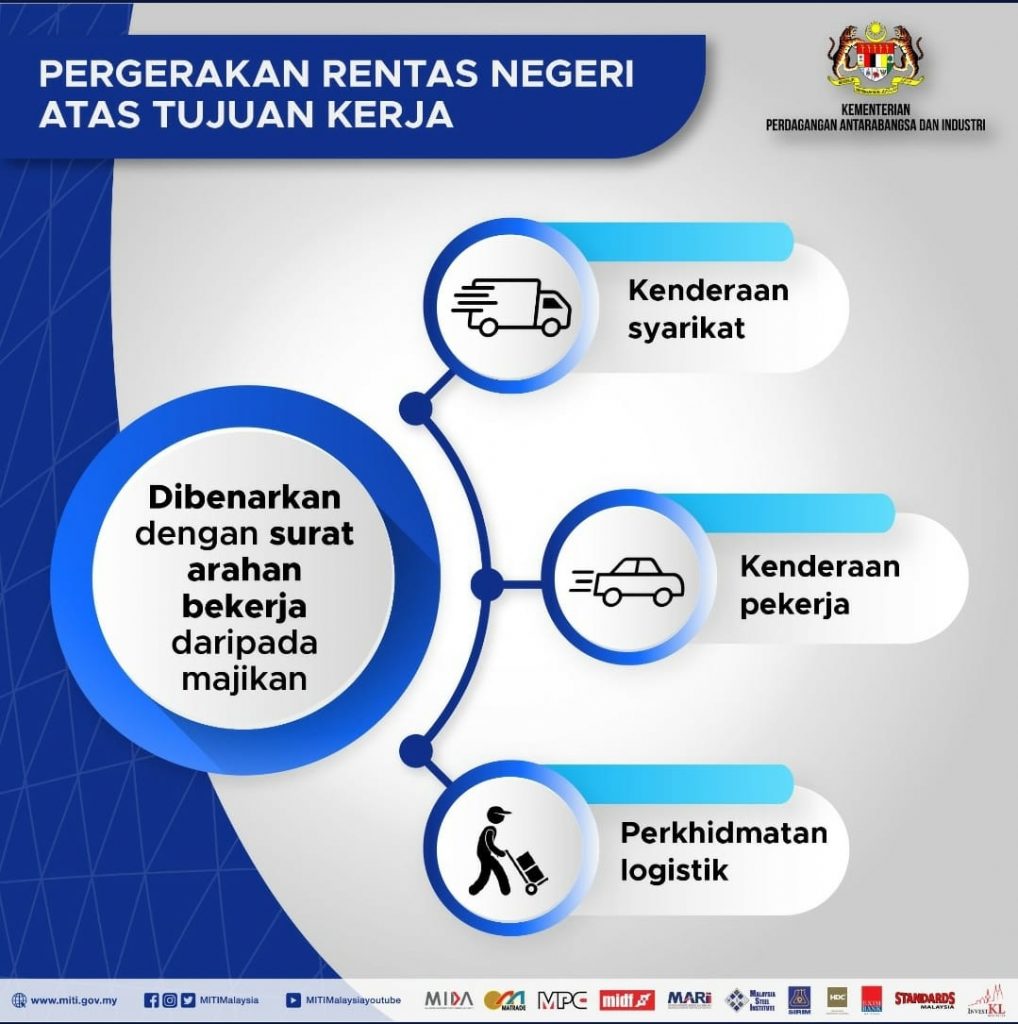
The Inter-State movement for the purpose of work does not have to get the permission of the police, just a working letter from the employer. However, movement due other purposes requires police approval first. Company vehicles, worker’s vehicle, and Logistic Services allowed with work letter from employer. For the latest updates, please click here to visit the official Facebook page of MITI , or visit the MITI Portal here.
This guidance is not a standard or regulation, and it creates no new legal obligations. It contains recommendations as well as descriptions of mandatory safety and health standards. The recommendations are advisory in nature, informational in content, and are intended to assist employers in providing a safe and healthful workplace. The Occupational Safety and Health Act requires employers to comply with safety and health standards and regulations promulgated by OSHA or by a state with an OSHA-approved state plan.
The world in 2020 has been reshaped by the Covid-19 pandemic. Adoption of technology has become even more important than ever for businesses to excel in this new environment. The next issue will be to bring communities together. On 4 June 2020, EventBank held a panel discussion on how to bring communities closer in the digital age. The panellists were Toni Brearley, CEO Of Australian Society of Association Executives, Tay Ling, General Manager at Pico Group, John Peacock, Chief Executive Officer At Associations Forum and AMCHAM’s CEO Siobhan Das. Moderator for this session was Eric Schmidt, CEO & Co-Founder Of EventBank
Professional communities around the globe are struggling as the in-person method becomes less accessible and alternatives must be explored and utilized effectively to ensure business continuity and success. Considering the possibility that the in-person events may not be an option anytime soon, businesses have to find other means of providing content and value to their communities.
The panellists brought to the discussion their recent experiences in adapting to the new normal and the techniques employed as well as potential ideas that could help counter the lack of a physical space to maintain engagement with the communities. This includes how to improve the virtual experience for the target audiences and how those ideas can be marketable. Overall, a very insightful session in learning of new ideas and addressing key problems.
The world continues to be shaped by the Covid-19 epidemic, businesses continue to face unprecedented challenges. Countries in Asia are beginning to experience domestic de-escalation and governments are gradually lifting restrictions for business operations to resume. On 3 June 2020, AMCHAM held a webinar on preparing an organization for returning to operations, especially with the possibility that the ‘new normal’ becomes a permanent normal.
For this session, medical and security experts from International SOS – Dr Greg Jakubowski, Regional Medical Director, Dr Chan Yanjun, Medical Director and Aditya Luthra, Security Director were brought together. This webinar covered where Malaysia is currently with the epidemic, what to consider when reopening business operations including the planning and crisis management system, as well as, doing a ‘COVID-19 Audit’ and staying safe. Also covered were the security issues that can be expected to be seen in the coming months and the following year such as travel restrictions, social unrest, and more. Various case studies of effective practices were presented to the attendees.
A year after the initial announcement, the Ministry of Finance and the Inland Revenue Board on 21 May 2020 released the much-awaited Guidelines on the Application of Subsection 12(3) and 12(4) of the Malaysian Income Tax Act 1967 in determining a “Place of Business”.
These guidelines are of importance to a number of our member companies, as they have an impact on supply chains and other businesses in Malaysia. To help American companies in Malaysia understand the ramifications, we will hold a program to closely examine the legal provisions and accompanying guidelines.
The Guideline By Inland Revenue Board
Client Alerts:
By Deloitte
By EY