In many parts of Southeast Asia and beyond, the impact of COVID-19 remains severe. More than 18 months after the virus first began spreading, high caseloads and new variants are putting pressure on health systems. It’s a difficult time for people across the region, and heartbreaking for those who’ve lost loved ones.
Vaccines offer a path to stability and recovery, and Google is working closely with governments, health authorities and nonprofits as inoculation programs roll out. But there’s also an urgent need for the equipment that health workers depend on as they battle the pandemic and care for patients on the front lines.
Today, through our philanthropic arm, Google.org, we’re announcing a new, $2.5 million grant to help UNICEF and the International Federation of Red Cross and Red Crescent Societies (IFRC) — as well as partners on the ground — scale up the COVID-19 response in Indonesia, Malaysia, Thailand, Vietnam, the Philippines and Pakistan.This will provide critical, life-saving support to the people who need it most.
In addition to funding this immediate medical response, Google.org will provide a further $5 million in ad grants so local government agencies and organizations like UNICEF can run public information campaigns — ensuring important health messages reach the widest possible audience.
On 28 July 2021, SMART Modular Technologies completed its 1st dose at the Flextronics vaccination centre (PPV).
By now, they have achieved 96% of employees vaccinated. This was all possible thanks to the great coordination Flextronics management & PPV operations team, enabling the completion of mass vaccination of employees ahead of time.
The Malaysia Tech Month 2021 returns for the second year featuring stellar line up of internationally-renowned speakers such as Professor Dr. Michio Kaku, Theoretical Physicist, Bestselling Author, Acclaimed Public Speaker, Renowned Futurist & Populariser of Science; Dr Luc Julia, Chief Scientific Officer of Renault Group and the Co-Creator of Apple Siri; Michael Tchong, Futurist and Author; Inma Martinez, Digital Pioneer and A.I. Scientist, UK; Taavi Kotka, First Former Chief Information Officer, Estonian Government; Ivana Bartoletti, Technical Director – Privacy, Deloitte & Co-Founder, Women Leading in AI Network, UK.
The Malaysia Tech Month 2021 (MTM’21) is a virtual, month-long curation of electrifying digital and technology content geared toward promoting investments in the digital economy, organised by Malaysia Digital Economy Corporation (MDEC), Malaysia’s lead agency in digital transformation.
The newly established HR Committee for AMCHAM Malaysia hosted their webinar on 28 July to kick-off a series of learning/networking sessions to discuss key issues related to talent, HR and organizational matters in Malaysia. Titled `What Matters in a Hybrid Working Model – the Malaysia Experience’, the session was led by a panel represented by Sugunah Verumandy, Country Head of Human Resources at HSBC Bank Malaysia Berhad; Anwar Yusoff, General Manager, HR & Administration at ConocoPhillips Malaysia; and Mensielito Teofisto, Asia Lead for Strategic Employee Relations at Intel.
The discussion, attended by HR professionals and members of AMCHAM, focused on the Future of Work driven by a new model of `hybrid work’. A timely topic, in view of the pandemic which has galvanized employers to look at new ways of working for their workforce.
To set the stage, Sugunah shared lessons learned from the pandemic through the lens of HSBC Malaysia:
- Technology has enabled continuity of operations, and rapid connection
- Shift in customer behavior where we are seeing more trust in online transactions and engagement
- Shift in employee mindset where we are seeing more flexibility and autonomy in choosing where/ when/ how to work
Today, employees are moving towards a preference towards `work from home’ and see the office mainly as a space to socialize. Like many employers, HSBC has developed a `hybrid work’ model to address the different work personas, depending on job scope and needs.
The pitfalls and challenges
Mensielito presented on the pitfalls and challenges to a hybrid model. When designing the right strategy, key questions to ask are: do we adopt a centralized or decentralized approached? The strategy should reflect the inherent culture of an organization – is it input based or output based?
Some of the challenges to consider:
- Benefits – do we scale back or adjust depending on the work location of employees?
- Office space – do we need to reconfigure to accommodate this change?
- Employee engagement/ collaboration – how do we ensure there is rigor and structure?
- New hires – how do we integrate new talent?
Whatever the strategy, it is important for leaders across the organization to advocate, stand behind the company model.
Making success possible
ConocoPhillips certainly has a strong framework in place – Anwar shared some attributes to help make the hybrid working model a success:
- Provide options to employees and lock-in commitment
- Define core hours – it could be fixed (eg. 9am-4pm) or flexible (eg. anytime provided is 8 hours/ day)
- WFH set-up – look at ways the employer can support with a focus on EHS
- Company culture – there is no one-size-fits all. An effective model should suit the company culture
- Productivity levels need to be maintained
The implementation of the new hybrid work model will be a journey – a learning mindset is key, while recognizing that there should be room to make mistakes, learn, hear from employees and pivot. The ultimate goal is to create an inclusive environment where employees feel empowered….to grow and better serve the communities where we operate.
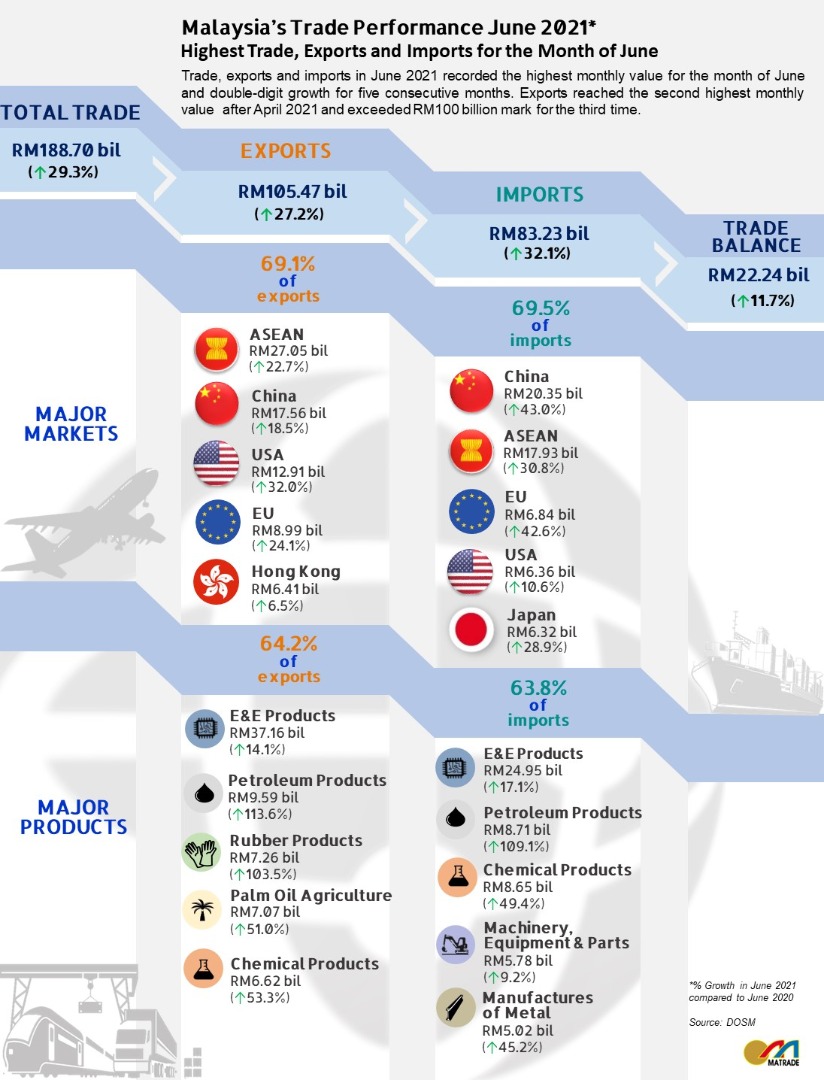
Malaysia’s trade performance continued the growth momentum in June 2021 with trade increasing by 29.3% to RM188.7 billion compared to June 2020. Exports recorded the 10th consecutive month of year-on-year (y-o-y) expansion since September 2020, registering a strong growth of 27.2% to RM105.47 billion. This was the third time exports exceeded RM100 billion. Imports increased by 32.1% to RM83.23 billion and trade surplus expanded by 11.7% to RM22.24 billion. Trade, exports and imports recorded the second highest monthly value thus far after April 2021. This was also the highest monthly value for the month of June and double-digit growth for five successive months.
The export growth was contributed by strong demand for petroleum products, electrical and electronic (E&E) products mainly electronic integrated circuits used in the production of smartphones, cars, computers and home appliances as well as rubber products. Exports to all major markets namely ASEAN, China, the United States (US), the European Union (EU) and Japan recorded double-digit expansion.
AMCHAM was once again invited by the Chartered Tax Institute of Malaysia to be a part of the National Tax Conference (NTC) 2021 held from July 27 to 28. Our CEO Siobhan Das alongside Abu Tariq Jamaluddin, Deputy Chief Executive Officer (Policy) of LHDN and Steve Chia, Council Member of the Chartered Tax Institute of Malaysia moderated by Soh Lian Seng, Council Member of the Chartered Tax Institute of Malaysia spoke on the topic Issues Relating to COVID-19 (Domestic & International Issues), a very timely topic of discussion.
The discussion surrounded the disruption to livelihood and businesses brought on by the COVID-19 pandemic, within the context of taxation. Speakers elucidated on the measures introduced by the government such as tax incentives and tax exemptions to alleviate the disruption and assist adaptation to the new normal.
Special thanks to both LHDN and the Chartered Tax Institute of Malaysia for giving the opportunity to our CEO to present the American business perspective at this prestigious annual tax event. Congratulations on a well-organized virtual conference.